
Act 58 of 2025: What Pennsylvania's New DUI Law Means
Pennsylvania recently enacted Act 58 of 2025, a new DUI law that updates and clarifies how certain DUI cases are charged and sentenced. The legislation was prompted by recent court decisions that created uncertainty in how prior DUI-related matters—especially cases resolved through diversion—were treated.
The law is now in effect and applies to cases going forward.
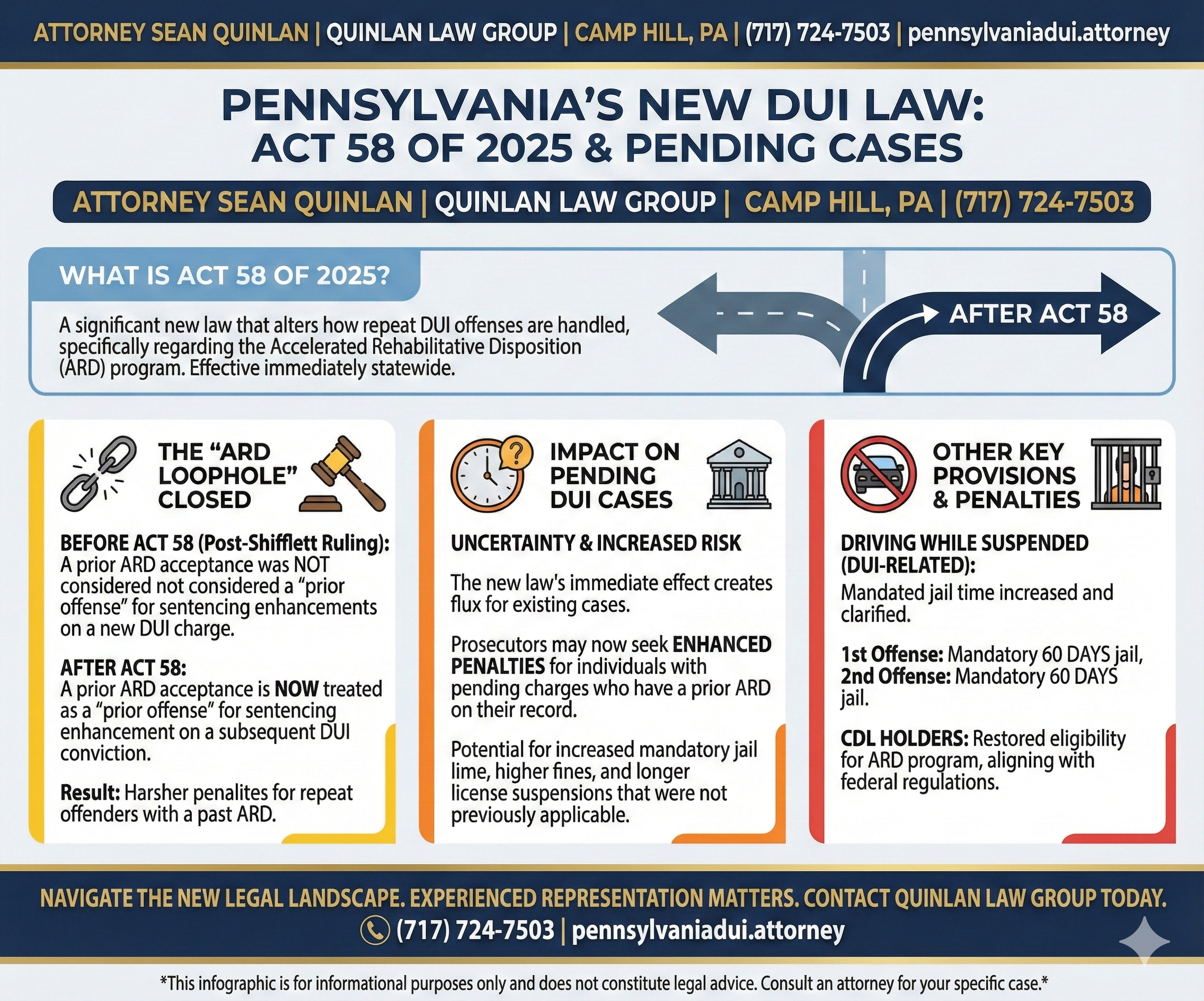
PA DUI Law Update: Pennsylvania’s new DUI law, Act 58 of 2025, is now in effect and impacts pending DUI cases in Dauphin County, Cumberland and York Counties—particularly how prior DUI’s or prior ARD are counted.
The law does not automatically change every case, and ARD remains available for eligible first-time offenders. How this applies depends on your prior criminal history and where your case stands.
Speak with a Attorney Sean Quinlan to understand how the new law affects you and your case.
Key Takeaways from Act 58 of 2025
1. Prior ARD Can Now Count in Later DUI Cases
Act 58 closes what lawmakers described as an "ARD loophole." Previously, a DUI resolved through Accelerated Rehabilitative Disposition (ARD) did not count as a prior offense because ARD is not a conviction. Under the new law, a DUI committed within 10 years of completing ARD may be treated as a subsequent offense for sentencing purposes.
2. New "DUI Following Diversion" Category
The statute creates a specific framework for handling DUIs that occur after a prior diversionary resolution, providing clearer guidance to courts and prosecutors.
3. Clarifies Mandatory Sentencing Provisions
Act 58 updates statutory language to align with recent Pennsylvania and U.S. Supreme Court rulings. This includes clearer rules for mandatory jail time in certain DUI-related offenses, such as driving under a DUI-related license suspension.
4. ARD Is Still Available for Eligible First-Time Offenders
Importantly, Act 58 does not eliminate ARD. First-time, eligible offenders may still qualify for diversion. The law primarily affects how repeat conduct is evaluated.
Does Act 58 Affect Pending Cases?
If a DUI case is still pending, Act 58 may apply, depending on the individual's prior history and the procedural posture of the case. It does not automatically increase penalties and does not reopen cases that have already been resolved.
Bottom Line
Act 58 of 2025 is best understood as a clarification and tightening of repeat-offender rules, not a wholesale overhaul of Pennsylvania DUI law. Its impact varies significantly based on a person's record and the timing of their case.
If you are facing a DUI charge or have questions about how this new law may affect your situation, speaking with an experienced Pennsylvania DUI attorney is critical.
